
SURJAN SUPER SCHOOL

 |  |
|---|---|
 |  |
 |  |
 |  |

The Liminal Architect: A Comprehensive
Monograph on the Practice of Surjan

1. Introduction: The Architect as Transdisciplinary Provocateur
The trajectory of the American architect and educator Surjan (formerly known as T. Joseph Surjan or Terry Surjan) presents a singular case study in the evolution of contemporary design practice. Spanning over three decades, Surjan’s body of work resists the convenient classifications of the architectural profession, moving fluidly between the tectonic rigor of built environments, the high-stakes theater of national memorialization, and the avant-garde frontiers of narrative and genderqueer spatial theory.
Surjan, who utilizes they/them pronouns, serves today as a Professor of Practice at The Design School at Arizona State University (ASU). Their career operates at the volatile intersection of the academy, the construction site, and the speculative avant-garde. From early experiments with "Form-Z" modeling at SCI-Arc and the algorithmic "SuitCase Pavilion" at Virginia Tech to the current "Surjan Super School," the work consistently interrogates the stability of the physical world.
This monograph provides an exhaustive analysis of Surjan’s career, anchoring the narrative in two pivotal moments of institutional recognition: the receipt of the Young Architects Award from the Architectural League of New York in 2000 and the selection as a finalist in the Flight 93 National Memorial international design competition in 2005. It argues that Surjan’s primary contribution is a "Liminal Methodology"—a practice that prioritizes the threshold over the room, the transition over the state, and fluid identity over the fixed subject.
2. Foundations: Education and the East Coast Avant-Garde (1989–1994)
To understand Surjan’s pedagogical approach, one must return to the formative years of their education, a period characterized by the waning of Postmodernism and the explosive arrival of the Digital Turn.
2.1 The Academic Crucible: UPenn and Columbia GSAPP
Surjan’s academic path began with a rigorous grounding in analog representation. During the 1989–1990 academic year, they served as a Teaching Assistant for the "Drawing Seminar" at the University of Pennsylvania, a bastion of Beaux-Arts rigor where hand drawing was the primary site of investigation.1 This foundation provided the "genetic code" for Surjan’s later digital work; unlike "digital natives," Surjan belongs to the bridge generation that learned to draw before they learned to code.
Surjan subsequently earned a Master of Architecture from Columbia University’s Graduate School of Architecture, Planning and Preservation (GSAPP) in 1994. This period coincided with the deanship of Bernard Tschumi and the "paperless studio" initiative. As a Teaching Assistant for "Core Studio I" (1993-1994) and a member of the Admissions Review Committee, Surjan was positioned at ground zero of the digital revolution, absorbing the theories of folding, complexity, and continental philosophy that defined the era.
2.2 Apprenticeships: The Divergent Masters
Surjan’s professional resume reads as a curated tour of the late 20th century's most influential methodologies. The diversity of these mentorships suggests a synthesis of conflicting dogmas:
Firm Period Key Methodology/Influence
Stanley Tigerman (Chicago)1986–1989
Postmodern Irony. Tigerman instilled a willingness to disrupt established canons with humor and history.
Bohlin Cywinski Jackson (Philadelphia)1990–1991
Tectonic Materiality. BCJ emphasized the "nature of materials," visible in Surjan’s later wood/stone detailing.
Steven Holl Architects (New York)1992–1994
Phenomenology. Holl’s focus on light, texture, and the bodily experience of space is the most significant influence on Surjan’s memorial work.
Reiser + Umemoto (New York)1993–1994
Complexity & Form. Pioneers of the "geodesic," R+U added a layer of algorithmic formal experimentation to Surjan’s skill set.
3. The Digital Frontier: SCI-Arc and the League Prize (1998–2000)
Following Columbia, Surjan moved to the West Coast, serving on the faculty at the Southern California Institute of Architecture (SCI-Arc) from 1998 to 2001. This era marked the transition from "high theory" to "radical experimentation."
3.1 The Form-Z Joint Study
Surjan served as the "form-Z Principal Investigator" at SCI-Arc. In an era before 3D modeling was ubiquitous, Surjan developed methodologies to teach complex boolean modeling to students with no computing experience. This role established Surjan as a "technologist-pedagogue," treating the computer not just as a drafting tool but as a generative engine.
3.2 The Architectural League Prize (2000): "Second Nature"
In 2000, Surjan achieved a defining milestone by winning the Young Architects Award (now the Architectural League Prize) from the Architectural League of New York.
-
The Theme: The competition theme was "Second Nature," asking entrants to address how nature had become "altered, simulated, and artificial."
-
The Proposal: Surjan’s entry engaged with "The Architecture of Electronic Space," positing that electronic space had become a primary environment for human habitation—a "second nature" where deformation is understood as "degrees of difference rather than formal aberrations."
-
The Cohort: This win placed Surjan alongside rising stars like Minsuk Cho and Julia Czerniak, validating their work at the cutting edge of the "landscape turn" and the "digital turn."
4. The Monumental Phase: Flight 93 National Memorial (2005)
Five years after the League Prize, Surjan engaged in one of the most significant public design efforts of the post-9/11 era: The Flight 93 National Memorial International Design Competition.
4.1 "Fields, Forests, Fences"
Out of over 1,000 entries, Surjan and landscape architect Laurel McSherry were selected as one of five finalists. Their proposal, titled "Fields, Forests, Fences," was distinct for its ecological and phenomenological sensitivity.
-
Evolving Landscape: Unlike static monuments, the proposal treated the site as an evolving organism. It allowed natural succession to heal the scars of the crash and the former strip mine, stating, "The ridge and bowl become meadows."
-
The Sacred Grove: The team proposed a birch grove near the Sacred Ground containing 40 stone markers. This created a "memorial final resting place" that was intimate and vertical, conceptually treating "the sacred ground as sacred grove."
-
Forestry Tags: Acknowledging the spontaneous memorials left by visitors (hats, flags, rosaries), the design incorporated "forestry tags"—small markers visitors could write on and attach to the fences or trees. This transformed the memorial into a dynamic archive of public grief, anticipating the "participatory turn" in design.
Although they did not win the final commission, the selection of this proposal validated Surjan’s ability to handle complex national narratives through landscape and form.
5. The Tectonic Phase: Virginia Tech and Algorithmic Fabrication (2005–2011)
From 2005 to 2011, Surjan served as an Associate Professor at Virginia Tech, a school historically known for its focus on construction and craft. Here, Surjan synthesized their digital background with physical fabrication.
5.1 The "SuitCase Pavilion" and WIRED NEXTFest
In 2008, Surjan led an undergraduate research team in the design and fabrication of the "SuitCase Pavilion/Gateway 2.0" for WIRED Magazine’s NEXTFest in Chicago.
-
The Constraint: The project was titled for its primary constraint: portability. The entire pavilion, which served as the entry archway for the festival, had to be modular and packed into standard airline suitcases by the students.
-
The Scale: The structure consisted of over 14,000 unique parts, requiring a "File-to-Factory" workflow where students managed the entire process from code to CNC milling.
5.2 Technical Research: The Adaptive Ball Drop Algorithm
The "SuitCase Pavilion" was underpinned by serious algorithmic research. Surjan and the team developed the "Adaptive ball drop algorithm for toolpath generation."
11
-
The Problem: When milling complex 3D surfaces with a 3-axis mill, the drill bit can "gouge" or overcut the material if the surface is steep.
-
The Solution: Surjan’s algorithm "simulated" dropping a virtual ball (representing the drill bit) onto the 3D mesh to calculate exact toolpaths that prevented overcutting. This allowed the team to fabricate complex, interlocking components that fit together perfectly, bridging the gap between digital perfection and physical reality.
5.3 Game Engine Physics
During this period, Surjan also presented research titled "Appealing to the Masses" (ACADIA 2004), which argued for using game engine physics (gravity, collision detection) in architectural design. This "digital empiricism" allowed architects to test if a structure would stand up or stack correctly inside the computer before cutting a single piece of wood.
6. The Narrative Turn: Chicago (2012–2019)
In 2011, Surjan relocated to Chicago, teaching at the Illinois Institute of Technology (IIT) and later the School of the Art Institute of Chicago (SAIC). This period saw a shift from "building" to "storytelling."
6.1 Chicago Underground Practice (C_UP)
In 2012, Surjan founded C_UP, a "design collaborative" structured as a family collective with Stephanie Surjan (Digital Design Chair) and Luca Surjan (Creative Director). The practice focused on speculative competitions and "narrative architecture."
-
"Ivy Girl & the Cloverleaf": This project was a finalist in the Fairy Tales competition and published in Fairy Tales: When Architecture Tells a Story (2014). It used the medium of the fairy tale to explore the collision between organic life (Ivy) and infrastructure (Cloverleaf), effectively treating text as a form of architecture.
-
"Reimagine the Astrodome": In the "King of Texas" proposal (2013), C_UP argued for preserving the Houston Astrodome based on its social history—specifically Billie Jean King’s "Battle of the Sexes" tennis match. This marked an early engagement with gender politics, proposing a program based on gender equality rather than just adaptive reuse.
6.2 Pedagogical Shift: Light and Space
At SAIC, Surjan’s teaching moved toward the atmospheric. The course "Light and Space" explored lighting as a tool for defining architecture, a lineage from Surjan’s time with Steven Holl. This era focused on "interiority" and the psychological dimensions of space.
7. The Speculative Future: Genderqueer Architecture (2020–Present)
The current phase of Surjan’s career is centered at Arizona State University, where they serve as a Professor of Practice. This era is defined by the explicit integration of personal identity into professional methodology.
7.1 Genderqueer Spatialities
Operating under the moniker Genderqueer Architecture, Surjan now researches "genderqueer spatialities."
-
Theory: The work challenges the binary assumptions of traditional architecture (public/private, hard/soft).
-
Form: Utilizing inflatable structures, Surjan explores forms that are fluid, pressurized, and non-static—metaphors for a non-binary identity that refuses to be fixed.
7.2 The Surjan Super School and AI
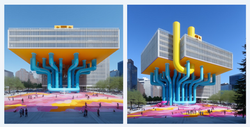
The "Surjan Super School" is an online research platform and educational initiative that utilizes Artificial Intelligence (AI) to bypass physical constraints.
-
Methodology: Surjan uses AI-generated imagery to visualize "transdisciplinary representation" and "speculative infrastructures."
-
The Archive: The project seeks to "reimagine the archive as a vessel for memory, identity, and community." This connects back to the Flight 93 "forestry tags"—an interest in how memory is stored—but transfers it from the physical fence to the digital cloud.
8. Comparative Analysis: The Evolution of a Practice
To visualize the trajectory of Surjan’s career, we can categorize the output into three distinct phases, each defined by a different relationship to "Nature" and "Identity."
Phase Time, Period Key, Project Relationship, to Nature Relationship to Identity
I. The Phenomenological Turn1994–2005
Flight 93 Memorial (Finalist)Healing Nature. Nature is a restorative force (birch groves, meadows) that covers the scars of the industrial past. Collective Identity. The focus is on the "40 heroes" and the nation. Identity is fixed in stone markers.
II. The Tectonic Turn2005-2011
SuitCase Pavilion Simulated Nature. Nature is physics (gravity, friction) simulated by algorithms to control material. Maker Identity. Identity is found in the "hand" of the maker, mediated by the machine (CNC).
III. The Narrative Turn2012–2019
Ivy Girl / Astrodome Narrative Nature. Nature is a character in a story ("Ivy Girl"). It is symbolic and literary. Historical Identity. Identity is political (Billie Jean King). It is about reclaiming history for marginalized groups.
IV. The Non-Binary Turn2020–Present
Surjan Super School Digital Nature. Nature is AI-generated, atmospheric, and simulated. It is "Second Nature" realized. Fluid Identity. Identity is genderqueer, nonbinary, and personal. It is the generator of form (inflatables).
9. Conclusion
Surjan’s career is a testament to the power of the "liminal." They have successfully navigated the transition from the analog rigor of the 1990s to the fluid, AI-driven speculation of the 2020s.
Their practice is anchored by the 2000 Architectural League Prize, which identified them as a visionary of "Second Nature," and the 2005 Flight 93 Memorial selection, which proved their capacity for profound emotional design. Yet, Surjan refused to settle in either the "digital" or the "monumental" camp. Instead, they evolved into a "design scientist" of identity, using inflatables, algorithms, and narratives to dismantle architectural orthodoxies. Whether coding a CNC mill at Virginia Tech or prompting an AI at ASU, Surjan’s work remains consistent in its quest to create frameworks where life—messy, fluid, and unpredictable—can unfold.
